
ABA licensing requirements vary by state. As of 2025, 40 U.S. jurisdictions (39 states plus Washington, D.C.) have enacted behavior analyst licensure or registration laws. Most require BCBA certification as part of the process. A handful of states still have no formal licensing law on the books, though BACB certification remains the professional standard nationwide.


The landscape of ABA licensing has changed a lot over the past 30 years. Florida was the first state to operate a formal behavior analyst certification program, and the evolution of ABA licensing has been accelerating ever since. Today, the vast majority of states have licensing laws in place, and the ones that don’t still recognize BCBA certification as the de facto credential for qualified practitioners.
That patchwork history is actually good news for you. It means the profession has matured, that insurance companies take it seriously, and that licensed behavior analysts have more professional standing than ever before. It also means what’s required to practice in Texas looks different from what’s required in New York, which is why this guide exists.
The Behavior Analyst Certification Board (BACB), a national nonprofit established in 1998, has been the connective tissue holding all of it together. The BACB offers the BCBA credential and provides direct support to state regulatory bodies. The Association of Professional Behavior Analysts (APBA) maintains the Model Licensure Act, the recommended legislative framework that most state licensing laws draw from. The BACB actively endorses this model and helps regulators put it to work.
How ABA Licensing Works in the U.S.
There’s no national ABA license. Each state sets its own requirements, and state licensing departments are responsible for issuing credentials. In practice, this usually means one of two things: either a dedicated behavior analyst board evaluates applicants and sets standards, or an existing medical or psychological board takes on that role.
In states without a specialized board, the licensing department handles evaluations directly, typically weighing education and experience more heavily than examinations. The result is a wide range of requirements across the country, from states that closely mirror the APBA Model Licensure Act to states still working out the details.
The good news is that the BCBA credential travels well. Because so many state licensing laws are built on BACB standards, earning your BCBA often satisfies the core requirements for state licensure wherever you land.
What It Takes to Become a Licensed Behavior Analyst
In nearly every state, even those that don’t require the BCBA specifically, a master’s degree is the baseline for licensure. Beyond that, most licensing frameworks require some combination of graduate-level coursework in behavior analysis, supervised fieldwork, and a passing score on the BCBA exam.
The BCBA credential currently offers four certification pathways, organized by degree type and professional experience. Fieldwork requirements under current BACB standards include either 2,000 hours of supervised fieldwork or 1,500 hours of concentrated supervised fieldwork. It’s worth knowing that the BACB has announced upcoming changes effective January 1, 2027, including a reduction from four pathways to two. For the most current and detailed requirements, visit the BACB’s website directly or review our complete guide to BCBA certification.
ABA Licensure by State
Click your state below for detailed information on the specific licensing requirements where you plan to practice.
ABA License Requirements by State
- Alabama
- Alaska
- Arizona
- Arkansas
- California
- Colorado
- Connecticut
- Delaware
- District of Columbia
- Florida
- Georgia
- Hawaii
- Idaho
- Illinois
- Indiana
- Iowa
- Kansas
- Kentucky
- Louisiana
- Maine
- Maryland
- Massachusetts
- Michigan
- Minnesota
- Mississippi
- Missouri
- Montana
- Nebraska
- Nevada
- New Hampshire
- New Jersey
- New Mexico
- New York
- North Carolina
- North Dakota
- Ohio
- Oklahoma
- Oregon
- Pennsylvania
- Rhode Island
- South Carolina
- South Dakota
- Tennessee
- Texas
- Utah
- Vermont
- Virginia
- Washington
- West Virginia
- Wisconsin
- Wyoming
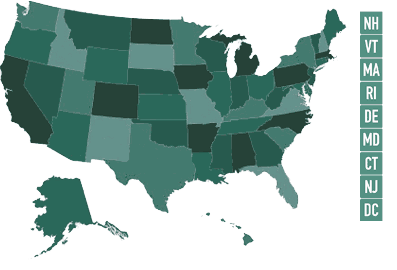
State-by-State Licensing Overview
All states fall into one of three categories based on how they approach behavior analyst licensing. States that adopted requirements earlier tend to have more detailed and settled processes. Click any state above for full details.
License Available, BCBA Required
These states and jurisdictions have formal licensing or registration laws in place and require BCBA certification as part of the licensing or registration process.
Alabama
Regulatory Body: Department of Mental Health, Division of Developmental Disabilities | Law Adopted: 2014
Arkansas
Regulatory Body: Arkansas Psychology Board | Registration Enacted: 2025
Arkansas established a standalone behavior analyst registration program under Act 432 (signed April 2025). BCBA or BCBA-D certification is required for registration. Note that this is a registration program, which is a distinct legal status from full licensure.
District of Columbia
Regulatory Body: DC Board of Psychology | Law Adopted: 2024
Hawaii
Regulatory Body: Hawaii Department of Commerce & Consumer Affairs | Law Adopted: 2015
Illinois
Regulatory Body: Illinois Department of Financial and Professional Regulation (IDFPR) | Law Enacted: 2022 | Licensing Operational: January 2025
The Behavior Analyst Licensing Act (225 ILCS 6) was signed into law in 2022. IDFPR began issuing licenses on January 15, 2025. BCBA certification is required.
Kentucky
Regulatory Body: Kentucky Applied Behavior Analyst Licensing Board | Law Adopted: 2010
Massachusetts
Regulatory Body: Board of Registration of Allied Mental Health and Human Services Professionals | Law Adopted: 2013
Mississippi
Regulatory Body: Mississippi Autism Board | Law Adopted: 2015
Missouri
Regulatory Body: Missouri Behavior Analyst Advisory Board | Law Adopted: 2010
Nevada
Regulatory Body: Board of Psychological Examiners | Law Adopted: 2009
Oklahoma
Regulatory Body: Oklahoma Licensed Behavior Analyst Board | Law Adopted: 2009
Tennessee
Regulatory Body: Applied Behavior Analyst Licensing Committee | Law Adopted: 2014
Virginia
Regulatory Body: Board of Medicine | Law Adopted: 2012
Wisconsin
Regulatory Body: Wisconsin Department of Safety and Professional Services | Law Adopted: 2010
Wyoming
Regulatory Body: Wyoming Board of Psychology | Law Passed: 2022 | Licensing Began: January 2023
BCBA certification is legally required. Wyoming adopts BCBA certification as its competence standard and does not set separate educational or fieldwork requirements.
License Available, BCBA Optional
These states have licensing frameworks in place, but don’t require BCBA certification specifically.
North Dakota
Regulatory Body: North Dakota State Board of Psychologist Examiners | Law Adopted: 2011
New York
Regulatory Body: New York State Department of Education Office of the Professions | Law Adopted: 2014
Pennsylvania
Regulatory Body: Pennsylvania State Board of Medicine
Pennsylvania licenses “Behavior Specialists” rather than “Licensed Behavior Analysts,” which is a distinct credential from what most other states issue. BCBA certification is one qualifying pathway, but it is not strictly required. Multiple degree and experience pathways exist. Check the Pennsylvania state page for full details.
Washington
Regulatory Body: Washington State Department of Health | Law Adopted: 2015
States Without Formal Licensure
These states don’t require a state-issued license to practice applied behavior analysis. Most still have some form of recognition for BCBA-certified professionals through insurance requirements, Medicaid standards, or statutory protections around the use of the title.
California
A licensing bill was introduced in 2016 and later withdrawn. No behavior analyst licensing legislation has been enacted.
Colorado
A 2020 review by the Colorado Office of Policy, Research, and Regulatory Reform found that ABA falls under the state’s legal definition of psychotherapy. ABA practitioners aren’t required to register as unlicensed psychotherapists unless they engage in psychotherapy specifically. No formal ABA licensure exists.
Delaware
Behavior analysts aren’t regulated directly. State regulations for autism service providers define the profession and recognize BACB certification as a primary qualifying credential for service providers seeking insurance reimbursement.
Florida
Florida operated the first formal behavior analyst certification program in the country, beginning around 1985. The Florida Behavior Analysis Certification Program ran until October 2003, when the BACB assumed all certifying responsibilities. A 2014 licensing bill (SB 1212) died in committee, and no standalone licensing law has been enacted since. Individuals certified under the original Florida program may continue to use the FL-CBA designation within the state.
Idaho
No governing body or licensing laws are in place or pending at this time.
Maine
State insurance codes require BACB national certification for insurance compensation.
New Hampshire
Connor’s Law (HB 569) requires that state-regulated health insurance plans cover ABA therapy delivered by a person certified by the BACB, or performed under BACB-certified supervision. This is an insurance mandate, not a licensure law.
New Mexico
Professionals delivering ABA services as lead behavior analysts through the Medicaid system must hold BCBA or BCBA-D certification. No standalone state license exists.
South Carolina
As of 2019, Medicaid requires all supervisory and direct therapy ABA providers to be credentialed through the BACB for insurance reimbursement. No formal licensure law has been enacted.
West Virginia
A 2012 Sunrise Report found that BACB oversight provided adequate consumer protection for citizens of the state. No formal licensure has been enacted since that time.
Last updated: February 2026. Licensing laws change frequently. Always verify current requirements directly with your state’s regulatory body before applying.
Frequently Asked Questions
Do I need a state license to work as a behavior analyst?
It depends on your state. As of 2025, 40 U.S. jurisdictions (39 states plus Washington, D.C.) have enacted laws requiring licensure or registration for behavior analysts. In states without formal licensure, you don’t need a state license to practice, but you’ll likely still need BCBA certification to qualify for insurance reimbursement and work with most providers.
Does BCBA certification satisfy state licensing requirements?
In many states, yes. States that closely follow the APBA Model Licensure Act typically accept BCBA certification as the primary licensure qualification. A few states have additional requirements, so it’s worth checking your specific state’s page for the full picture.
What states don’t require an ABA license?
As of 2025, 10 states still lack a formal licensing law for behavior analysts, including California, Florida, Idaho, Colorado, and West Virginia. Most of these states still recognize the BCBA credential for Medicaid reimbursement and insurance purposes.
Can I transfer my ABA license to another state?
Reciprocity varies by state. Because licensing requirements differ, you’ll typically need to apply for licensure in each new state where you want to practice. Many states expedite the process for applicants who already hold a current BCBA credential.
What’s the difference between BCBA certification and state licensure?
BCBA certification is a national credential issued by the BACB. State licensure is issued by a state regulatory body and is legally required to practice in states that have licensing laws. In most licensed states, earning your BCBA is a requirement for getting the state license, or at a minimum, a qualifying pathway toward it.
Key Takeaways
- ABA licensing is state by state. There’s no national license for the profession. Each state sets its own requirements through its own regulatory body.
- 40 jurisdictions now regulate behavior analysts. As of 2025, 39 states plus Washington, D.C., have enacted licensing or registration laws, making it the standard across the country.
- BCBA certification is the common thread. Most licensed states require it, and even in unlicensed state,s it’s the recognized standard for insurance reimbursement and Medicaid eligibility.
- The credential travels well. Because most state laws draw from the APBA Model Licensure Act and BACB standards, your BCBA often satisfies core requirements wherever you plan to practice.
- Requirements change — verify before you apply. Licensing laws have evolved rapidly in recent years. Always confirm current requirements directly with your state’s regulatory body.
Ready to take the next step toward BCBA certification? Explore programs in your state and find out which ones align with BACB coursework requirements.